
By 6 PM, your eyes feel like there's sand in them. You rub them, blink hard, maybe reach for drops — and by morning, it's fine again. Then it repeats. If this sounds familiar, you're not imagining it, and you're far from alone: gritty, end-of-day eye discomfort is one of the most common early signs of dry eye disease, and one of the easiest to write off as "just a long day at the screen."
Because the sensation often disappears after a night of sleep, it is incredibly easy to ignore. Understanding why your eyes feel gritty as the day goes on, however, is the first step toward protecting your long-term vision and comfort.
That "Sand in Your Eyes" Feeling, Explained
When your eyes feel gritty, you are experiencing a physical warning system. That "sandy" sensation isn't figurative — your eyelids are experiencing real friction.
Every time you blink, your eyelid glides over the surface of your eye. Under normal conditions, this movement is perfectly lubricated by a continuous, microscopic layer of tears. When that lubrication breaks down, the delicate tissue on the inside of your eyelid rubs directly against the sensitive surface of your eye. The result is a scratchy, uncomfortable friction that your brain interprets as having dirt or sand trapped under the lid.
Your eyelids are experiencing real friction — not a metaphor. When the tear film breaks down, every single blink becomes a micro-abrasion against your eye's surface.
What's Actually Happening to Your Tear Film by Evening
To understand why this friction peaks by the evening, we have to look at the mechanics of your tear film. Your tears are not just water — they are a sophisticated, three-layer ecosystem:
The Three Layers of Your Tear Film
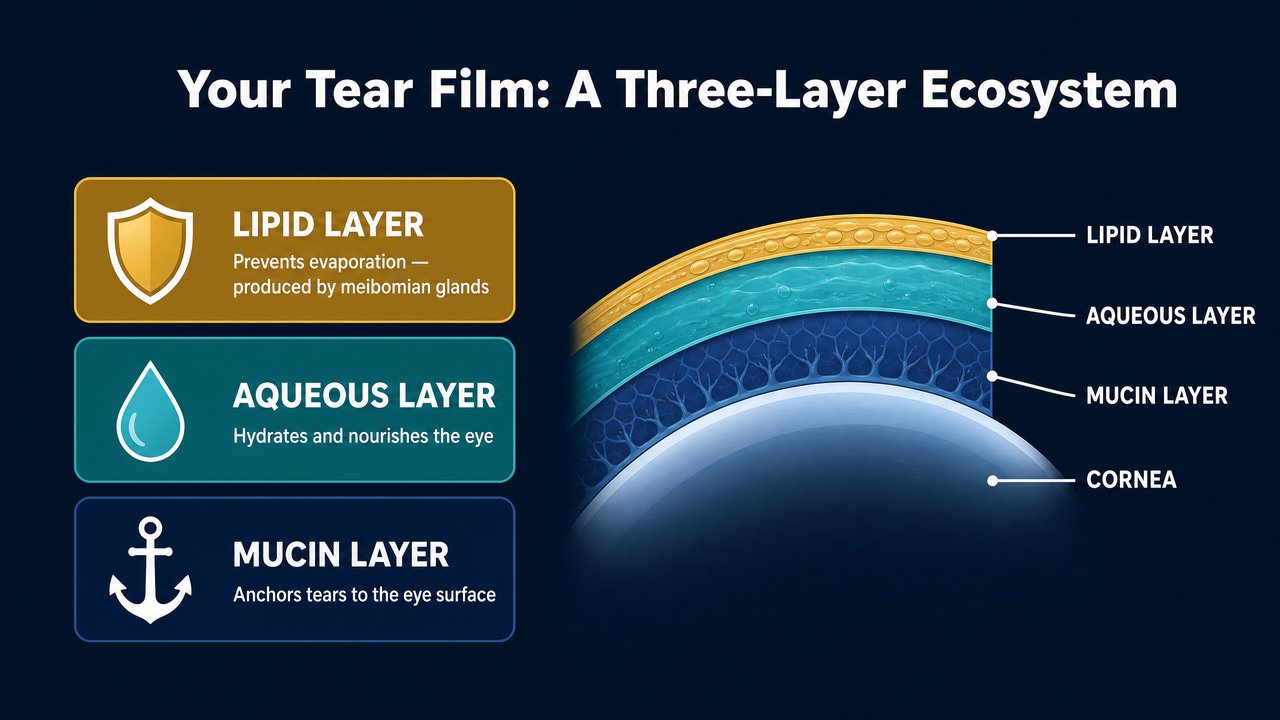
The tear film is a three-layer structure — when the outer lipid layer fails, rapid evaporation follows.
Throughout the day, environmental factors and physical fatigue wear this ecosystem down. By 5 PM or 6 PM, if your oil glands aren't producing enough high-quality lipids, the water layer of your tears evaporates too quickly. Without that protective shield, your eye surface dries out — leaving the nerve endings exposed to the physical friction of every single blink.
Take our quick, 2-minute symptom check to understand your ocular profile.
Common Triggers: Screens, Air, and Blinking Less Than You Think

Screen use reduces blink rate by up to 60% — a key driver of end-of-day dry eye symptoms.
While tear chemistry is the underlying cause, our daily habits are often the immediate triggers.
The biggest culprit in the modern office is "screen freeze." When we look at laptops, smartphones, or televisions, our blink rate plummets. On average, we blink about 15 to 20 times per minute. When focusing on a screen, that rate drops by up to 50–60%. To make matters worse, those few blinks are often "incomplete" — meaning the eyelids do not meet entirely, failing to spread a fresh layer of protective oils across the eye.
Combine a reduced blink rate with office air conditioning, overhead fans, or seasonal heating, and you have a perfect storm for rapid tear evaporation. This is why screen time and dry eyes are so closely linked — by the time your workday ends, your eyes have spent hours slowly losing their moisture barrier.
When Grittiness Is More Than Just a Long Day
It is incredibly common to dismiss evening grittiness because it "resets" overnight. While you sleep, your eyes are closed, evaporation stops, and your body has hours to rebuild a temporary layer of moisture. You wake up feeling refreshed, assuming the issue has resolved itself.
However, this daily cycle of daytime drying and overnight recovery is precisely how dry eye disease goes undiagnosed for years.
Occasional dry eyes from a windy day are normal. But if you experience grittiness multiple times a week — or it's progressively getting worse — your eyes are telling you that your tear film is chronically unstable.
Left untreated, chronic dry eye can lead to micro-scratches on the cornea, inflammation, and eventual damage to the oil-producing glands in your eyelids — making the condition progressively harder to treat.
What a Proper Evaluation Actually Looks Like
If you are tired of relying on temporary over-the-counter eye drops that only mask the symptoms for twenty minutes, it is time for a thorough clinical evaluation.
Modern dry eye care has moved far beyond simple "yes or no" clinical assessments. Because every patient's tear film is unique, a standard eye exam isn't always enough to pinpoint the exact breakdown in your tear layers. In a CSI-Powered Dry Eye Clinic, the diagnostic process is structured, objective, and designed around your lifestyle:
-
1
Pre-Visit Preparation
You share your symptoms and daily triggers from home before your appointment, allowing your doctor to focus entirely on you the moment you arrive. -
2
Advanced Surface Mapping
Instead of subjective assessment, clinicians use advanced digital diagnostics to measure your tear evaporation rate and assess the health of your oil glands. -
3
TFOS DEWS III–Guided Care
Your treatment plan is built using the TFOS DEWS III global standard — ensuring your care is staged specifically to the measured severity of your condition, not a one-size-fits-all recommendation.
You don't have to accept evening eye strain and grittiness as a tax for living in a digital world. Real, lasting relief starts with a clear answer.
Ready for a clear plan forward?
Find a CSI-powered clinic near you and get an answer that is thorough, precise, and tailored to you.
Find a CSI Powered Clinic Near You →